Podcast

Why Your Baby Refuses Foods They Used to Like...and What to Do About It

  • Why food rejection is a normal part of learning to eat, even when your baby liked that same food yesterday
  • What it actually means when your baby refuses a familiar food and why it does not mean they hate it forever
  • How to keep offering rejected foods without pressure so your baby can build diet diversity over time
LISTEN TO THIS EPISODE

Episode Description

Is your baby suddenly refusing a food they loved yesterday? Food rejection can feel frustrating when you’re just starting solid foods, but it’s also a very typical part of how babies learn to eat. In this episode, I’m explaining why babies may accept a food one day and refuse it the next, what this behavior actually means, and how to keep offering foods without pressure so your baby can build diet diversity over time.
null

Links from this Episode

  • Baby-Led Weaning with Katie Ferraro program with the 100 First Foods™ Daily Meal Plan, join here: https://babyledweaning.co/program and save $50 when you sign up using the code BLWPOD50

JOIN NOW AT $50 OFF CODE: BLWPOD50
null

null

Other Episodes Related to This Topic:

Click here for episode transcript Toggle answer visibility

Once Upon a Dance (0s):

This episode is sponsored by Once Upon A Dance. You know, I talk a lot here about helping your baby explore the world through food, but as your child gets older, there are so many other ways we can help them explore, imagine, and build confidence. And one of those ways is through movement. Now, I personally did not grow up doing dance myself. It wasn't a part of my childhood, but all three of my girls did dance. And I have to say it was such a formative experience for them. It wasn't just about learning steps or performing on stage. Dance helped them practice discipline, confidence, creativity, perseverance, and being part of something bigger than themselves. And that's why I love the idea behind Once Upon a Dance, these are interactive children's books that turn story time into movement time. So your child isn't just sitting and listening, they're twirling, leaping, imagining, and connecting with you through the story. Once Upon a Dance offers award-winning dance along stories created by a former dance teacher with her daughter Ballina Kay. As a gentle guide and positive role model, the stories celebrate friendship, family, self-acceptance, empathy, practice, perseverance and kindness, all through whimsical adventures featuring things kids love, like unicorns, bats, puppies, cats and more. So whether you're listening with the baby now or you also maybe have a toddler, a preschooler, or an older child at home who loves to move, this is such a sweet way to bring books, imagination and Activity together, swap screen time for connection, get your kids off the couch and into a story. Jump twirl and leap on over to once upon a dance.com or find once upon a dance books wherever you buy books online. That's once upon a dance.com.

Whisker (1m 45s):

Today's episode is sponsored by Whisker makers of the Litter Robot, the self cleaning litter box for cat families who do not need one more gross chore on their list. Because you know how every stage of parenting comes with a whole new category of cleanup, right? First it's the pump parts and then the dirty diapers you're getting used to. And when you're starting solid foods, suddenly you're scraping sweet potato out of crevices of the highchair that you never knew existed, right? But for cat parents adding daily litter box duty on top of all of that, that is a lot. And honestly, it's the litter box part. The thing that always made me hesitate about cats, not the cat, the litter, the scooping, the smell, the whole daily maintenance situation. And that's why Litter Robot by a Whisker makes so much sense. It automatically cycles after every use. So you're not scooping every day and you're not handling waste like you would with a regular litter box. I especially love the No Contact Benefit Litter Robot handles the dirty work so that nobody in the house has to be assigned daily litter duty. And with the Whisker app, you can stay on top of things without thinking about litter all day. The app can notify you about your unit, like completed clean cycles, litter and drawer levels, or when the unit needs attention. So whether you already have a cat or you're thinking about getting one, or you just want one less household chore to manage, Whisker helps Take litter box duty off of your daily list, maintain your cat's litter while focusing on your family. Learn more about Whisker litter robot models and their starter kits today so that you can get set up for this busy season of parenting. Take an additional $50 off bundles with the code weaning when you shop Whisker dot com slash weaning. That's an additional $50 off bundles with code weaning at Whisker dot com slash weaning.

Katie Ferraro (3m 40s):

Food rejection is a very typical thing that we see with starting solid foods. It actually means you're doing things right. It doesn't mean that your baby hates that food. It doesn't mean that you should stop offering that food. No, it doesn't mean your baby is becoming a picky eater, And it doesn't mean that you need to switch gears and start pressuring or bribing or distracting or sneaking bites of food in, okay? I don't want you to have to turn into a salesperson when you're at mealtimes. This is how you can deal with that food rejection, which I know is annoying because you spent like 28 minutes preparing and roasting all of the squash that they're now dropping on the floor, but it's not the end of the world. And here's why. Hey there. I'm Katie Ferraro, registered dietitian, college nutrition professor and mom of seven specializing in baby led weaning.

Katie Ferraro (4m 23s):

Here on the baby led weaning with Katie Ferraro podcast. I help you strip out all of the noise and nonsense about feeding, giving you the confidence and knowledge You need to give your baby a safe start to solid foods using baby led weaning. If your baby ate sweet potato yesterday and absolutely loved it, but then today they're acting like you offered them a shoe, you are not doing anything wrong because food rejection is a very typical part of starting solid foods. But it can feel frustrating, especially when you're working really hard to build that diet diversity.

Katie Ferraro (5m 3s):

And you finally thought, okay, great, we found some foods that work, but I gotta remind you, your baby's not a robot, okay? Their appetite, their mood, their energy level, things like teething and milk timing and interest in food, they're going to fluctuate from meal to meal. In today's episode, I'm going to walk you through why your baby may be refusing foods that they used to like what that rejection actually means, and then how to keep moving forward by offering familiar foods without pressure so that you can stay consistent, you can protect your baby's autonomy, and you can keep working them through those hundred First Foods so that they can develop that diet diversity and actually learn how to like real food.

Katie Ferraro (5m 48s):

Now, I like to start each of these mini training episodes with a baby led weaning tip of the day. And today's tip is rejection is not the same thing as dislike. Okay? I'll hear up here and say like, oh, my baby doesn't like broccoli. And it's like, wait a minute. You tried broccoli once. It doesn't mean you have to like pour nacho cheese all over it to get your baby to eat it, okay? Just because your baby rejects a food today does not mean that they hate that food, okay? It doesn't mean that you need to take it off the menu forever, And it definitely does not mean that you have failed. It simply means that today, right now, this snapshot, this moment in time, your baby was not interested in eating that food.

Katie Ferraro (6m 30s):

And that's okay. That's it. And I want you to hang tight because toward the end of today's episode, I'm gonna be giving you a really simple, well, what do I do next? Then plan for the next time your baby refuses a food that they used to like. I wanna tell you a real quick story because I know you know that every baby is different and people, even things people tell you like, oh, sleep when the baby sleeps. And you're like, that doesn't really happen in real life. People used to always tell me, oh, every baby is different. And I had one baby And I had struggled a ton with starting solid foods with her And it was a disaster. And then my next set of babies were quadruplets. So they came really quick on the heels of my first baby being born, And it was a total chaos.

Katie Ferraro (7m 11s):

And when it came time for my quadruplets to start solid foods, I waited until all of them were sitting up relatively on their own. So that was at their six month adjusted age was when they were about seven and a half months chronological age. 'cause they were born at 34 weeks, so they were six weeks premature. So I waited until they were six months plus six weeks to start solid foods. So that was hard enough because everyone around me was like, oh my gosh, they need to be eating food. And I'm like, they can't even sit up yet. And at that point, I didn't really know what baby led weaning was, but I knew I wanted to try it. We were gonna figure it out. And all of the babies were sitting at the table. They had this little quadruplet feeding table that I got from like a preschool supply store also, before I knew the importance of them having their feet resting flat on a solid foot plate, he's like plop them in these little buckets in the quad feeding table.

Katie Ferraro (7m 56s):

And I put the food out for them to eat. We started with avocado, and three of the four quads went to town. They're picking up the food and eating it, no problem. My son, Henry, on the other hand, put his head down on the table and refused to participate. And he did that for about the first six weeks of starting solid foods. The other babies were totally into it. And I remember thinking like, gosh, I bet if I only had one baby right now, I'd be totally freaking out and stressing out that something was wrong with this. But because I had this like control group of three other babies, and none of them are identical, by the way, they're all fraternal. But I knew he was physiologically ready to start solid foods, but he just wasn't interested.

Katie Ferraro (8m 37s):

And I knew I wasn't doing anything different with him than I was doing with the other three kids. It's just that Henry wasn't really ready or interested in starting solid foods. But if I pushed the food into his mouth or shoved a spoon of purees down his throat, that wasn't going to help him in that moment. He needed to wait until he was really ready. And I swear to you about six weeks after we started. So think about that. He was nine months old chronological age. Okay? So he was closer to his seven and a half month mark adjusted age. He picked his head up and he started participating. He was a little bit behind the other babies at first, but he very quickly caught up. And this is just your reminder that all babies get ready to eat on their own timeframe.

Katie Ferraro (9m 21s):

And not all babies are gonna eat the same foods at the same time. So I know you have friends whose babies eat more food than yours or faster than yours, or have done more allergenic foods. It doesn't matter. Compare and despair. Do not compare your baby to anybody else. 'cause even if you have multiples, you're gonna see one of them is gonna be eating faster than the other. And actually right now I'm working with a family in our community who has twins and it's so fun to watch. 'cause I also went on to have a set of twins after my quadruplets, And I knew what to expect that one of them was gonna be faster than the other. I have boy girl twins that were born when my quads were 18 months old. I had seven kids, three and under for a while, do not recommend zero stars, but at the time it was absolutely chaotic.

Katie Ferraro (10m 1s):

I love it. Now they're all so close in age and we do everything at the same time, And I think it's wonderful, but it was really tough back then. But I wasn't stressed about starting solid foods with the twins because I knew how to do baby led weaning. And I knew that the twins were gonna be eating at different paces and different rates. And it's so fun to watch the twins I'm working with now because they flip flopped. One of the twins started out faster and a little bit stronger than the other. And now that switched a few months in and the second twin is actually doing a little bit better than the other one. And it's not a competition, but it's just to remind you, all babies get ready at their own rate. And some days one twin will eat something and the other days the other one eats something that she wouldn't eat yesterday. And it's neither here nor there. But I wanna just acknowledge that food rejection can feel so frustrating.

Katie Ferraro (10m 41s):

So I wanna name this thing that makes this experience so annoying for you because when your baby is just starting solid foods, you are already carrying a huge mental load. I know you're trying to figure out when to offer food, how to cut the food safely. How soft does it need to be? How do I balance this with breast milk or formula? How do I reduce choking risk? I know I gotta get those allergenic foods in And I have to clean the high chair, And I just don't wanna lose my mind when the avocado gets smashed into the straps. And then finally you get to a point where your baby eats something, right? Maybe they loved your roasted zucchini boats that you made yesterday. Maybe they nod on some beef brisket last night. Maybe they pick the spoon up and self fed some oatmeal from it this morning.

Katie Ferraro (11m 22s):

And then you offer that same food again maybe later in the same day. And they look at you like you have five heads, throw it all on the floor, close their mouth or push it away and are like, absolutely not. And your brain immediately goes to, wait, what changed? Did I do something wrong? Did I make this food differently? Are they done with this food? Is this how picky eating starts? No, this is not a crisis. This is part of the learning how to eat process. Starting solid foods is not a linear process. It's not not gonna be your baby accepts the food once and then that food is permanently on the, like, I love this food forever list. Okay, I wish it worked that way. It would make my job a lot easier. But learning how to eat is a skill, okay?

Katie Ferraro (12m 4s):

And skill building is messy and it's not linear. Okay? Think about the way your baby is going to learn how to crawl and eventually walk, okay? They're not gonna do it perfectly one time and then execute it flawlessly every single day. After that, there's gonna be starts and stops. There's gonna be days where they got a lot of energy and they're really into it. And there's other days we're just gonna like lay on the stomach, roll over and look at you like, I ain't gonna do this for you. Okay? Eating works the same way. So why do babies reject foods that they used to like? Let's talk about why this happens. There are lots of reasons why your baby may refuse a food that they previously accepted. Okay? The first one, sometimes it has to do with appetite, okay? When you're just starting out with solid foods, we know that your baby does not yet know how to make food, make that feeling of hunger go away.

Katie Ferraro (12m 49s):

And that's because, you know, breast milk or formula still provides the majority of your infant's nutrition, even as they're learning to start solid foods. So as they get a little bit older and a little bit more proficient at eating solid foods, that's when appetite starts to play a role. And sometimes our older babies, they're gonna be interested in a lot of other things, right? They're starting to look around. And those of you, especially the breastfeeding moms, you know this, the older the baby gets, they're gonna be much more distracted when they're breastfeeding, much more distracted when they're at the table. And sometimes it has to do with their appetite if they're totally full of milk, or sometimes if they're really full of snacks and you put an older baby down at the table, they're gonna have absolutely no interest in food. So occasionally it will have something to do with appetite.

Katie Ferraro (13m 30s):

But if we think about our babies early on, they're not driven by appetite, right? Breast milk or formula is still providing most of their nutrition and they're at the table to learn how to eat. And learning how to eat is hard work, right? For you and me, it feels automatic. I'm hungry. I go to the kitchen, I put some food together, I put it in my stomach, they feel like I hunger goes away. Like go back to work. Okay? But for your baby, think about it. Eating involves posture, hand-eye coordination, grasping, bringing the food to their mouth, moving it around. Oh, it went too far in the back. Now I gotta gag a little bit. Eventually they learn how to chew. They manage the textures, they're gonna even start to swallow some of it. But at the very beginning, that's a lot of coordination. And oftentimes it'll tucker them out, okay?

Katie Ferraro (14m 11s):

And especially if we're tossing this into a routine where maybe they didn't have a great nap, or they're a little bit fussy, or they're teething or dealing with some constipation, which happens when we start solid foods. There's all sorts of reasons that could lead to your baby rejecting food, and honestly, it's not worth it to spend all your time and energy trying to figure it out. Okay? Another reason why a baby might reject food has to do with sensory learning. Okay, maybe your baby accepted a food yesterday, but today it might look different. Maybe the banana's a little riper or the avocado is colder, or the oatmeal is thicker. Maybe the chicken is shredded or the broccoli smells stronger. These might not be big differences to you, but for a baby who is still learning how food works, these changes are information.

Katie Ferraro (14m 51s):

And remember that learning how to eat is a full sensory experience, right? 'cause your baby is learning with their hands and their eyes and their nose, and eventually their mouth and their tongue and their gums. It's kinda a whole body experience, right? And they're not just asking like, do I like this? They're asking, what is this? Is it safe? What does it feel like? What happens when I squeeze it? What happens when I put it in my mouth? What happens when I spit it out? Okay? That process takes repetition, okay? And it's not on us to think, Ooh, do they like this? Do they like it cold? Maybe they like it warmer. I should heat it up a little. Stop micromanaging the situation. Or as my friend and colleague Marsha Dun Klein says, I said, I always worried about these moms who are micromanaging the situation, especially when they're like, you know, always telling the baby.

Katie Ferraro (15m 32s):

Great job, great job, great job. She said, Katie, don't say micromanaging. They're excessively cheerleading. So sometimes we have moms that are sitting there, they don't even realize it. They're trying to be positive, but they're just providing so much constant feedback that the baby just gives up on even trying to interact with the food because there's constant feedback from the parents. So sit at the side, observe your baby, but give them the space and the time that they need to learn how to figure out what to do with the food. Okay? We are not concerned with how much food your baby is eating early on because that doesn't really matter because, sorry, I'm sounding like a broken record here for the millionth time. Breast milk or formula is still providing the majority of the nutrition that your baby needs.

Katie Ferraro (16m 14s):

One of the underlying principles of baby led weaning, of course, is autonomy. So another reason that your baby may be refusing food might have to do with autonomy. This is a big one, baby led weaning is a responsive feeding approach, okay? Your baby has been communicating their hunger and their fullness cues from birth, right? When a baby is hungry, they cry. When they're full, they turn away from the breast or the bottle, they slow down, they stop sucking. They're showing us when they're done. Okay? Starting solid foods does not erase that. Your job is to offer those safe, age appropriate foods, and your baby's job is to decide whether they interact with that and how much food they eat and whether they want to eat and when they are done. So that means that sometimes your baby is going to say no. And I know that can feel hard when you've put so much time into making this food, okay?

Katie Ferraro (16m 57s):

But your baby's saying no. It's not a failure of your feeding approach. It's actually a successful part of that approach. Okay? You're doing your job, you're staying in your lane. We don't want you overriding your baby's cues or trying to support your baby in their ability to build skill, confidence and diet diversity without pressure. Hey, we're gonna take a quick break, but I'll be right back.

KiwiCo (17m 23s):

Last summer, I had this like epiphany moment where I looked around And I realized my kids are basically doing the same three things on repeat, snack, argue screens. And I remember thinking, okay, how are you supposed to make summer feel fun and adventurous without turning it into a full-time job for myself? And that's why this year I am very grateful for KiwiCo Kiwi CO's Summer Adventure Series has been such a lifesaver in our house. So KiwiCo delivers kits directly to your house that are, in my opinion, a godsend. Because again, I don't have all day to figure out stuff that we're going to be doing. We're doing the make and play kits because they came to my house and KiwiCo said, we are, what I love is how they instantly turn into an activity that actually sticks. So we opened up one crate, the kids get absorbed. They're trying something new, they get stuck. They figure it out again without asking me and without me needing to like swoop in and fix it or figure everything out. And then they wanted to take it outside and they kept going and they're like, mom watch, mom watch. Which I'm sorry, that's like my favorite type of like, mom, mom, mom, mom, mom for the summer. I love that noise as long as they want me to watch something that they actually put together by themselves. This summer Adventure series is designed to get kids outside and exploring and away from screens. They get six hands-on projects over six weeks with fun activities that go with each one. And it's super convenient because KiwiCo does the legwork for you. You can even choose to get all of the crates delivered at once, or you can have them arrive like kind of drip over a period of six weeks. So if you want to build the best summer ever, do check out KiwiCo. Get $10 off your summer adventure series at KiwiCo.com/summer promo code weaning. That's K-I-W-I-C-O.com/summer promo code weaning for $10 off.

Katie Ferraro (19m 18s):

So let's talk about what food rejection does not mean. Okay? Food rejection does not mean your baby hates your food. It doesn't mean you're a bad cook. It doesn't mean you should stop offering that food. It doesn't mean your baby's becoming a problem eat or needs feeding therapy right outta the gate. Okay? It also doesn't mean that you should switch gears and start pressuring or bribing or distracting or sneaking bites into your baby, okay? Please do not turn into a salesperson at mealtimes, okay? You don't need to say just one more bite. You don't need to clap dramatically every time they lick something. You don't need to pretend the spoon is an airplane or sneak food into your baby's mouth when they're not ready for it. Okay? Your baby needs repeated pressure-free opportunities to learn how to eat, okay?

Katie Ferraro (19m 59s):

And baby led weaning, you offer the foods, your baby is the one who feeds themselves. Now, what about this idea of 10 to 15 exposures? Maybe you've heard that baby sometimes may need to be exposed to a food 10 or 15 times depending upon what resource you see 10 or 15 times before they like or accept it. I wanna be careful here because I don't want you turning that into like another stressful checklist. Like, oh my gosh, we only done bulgar three times, So I have to do it 12 more times to get to the 15 mark before we determine that, oh, he doesn't like it and is on the do not feed list. That's not what we're talking about here. You don't have to offer parsnips 15 days in a row while everyone gets increasingly irritated that you're not making other foods for the rest of the family. Okay? What we're talking about is that repeated exposure does matter.

Katie Ferraro (20m 40s):

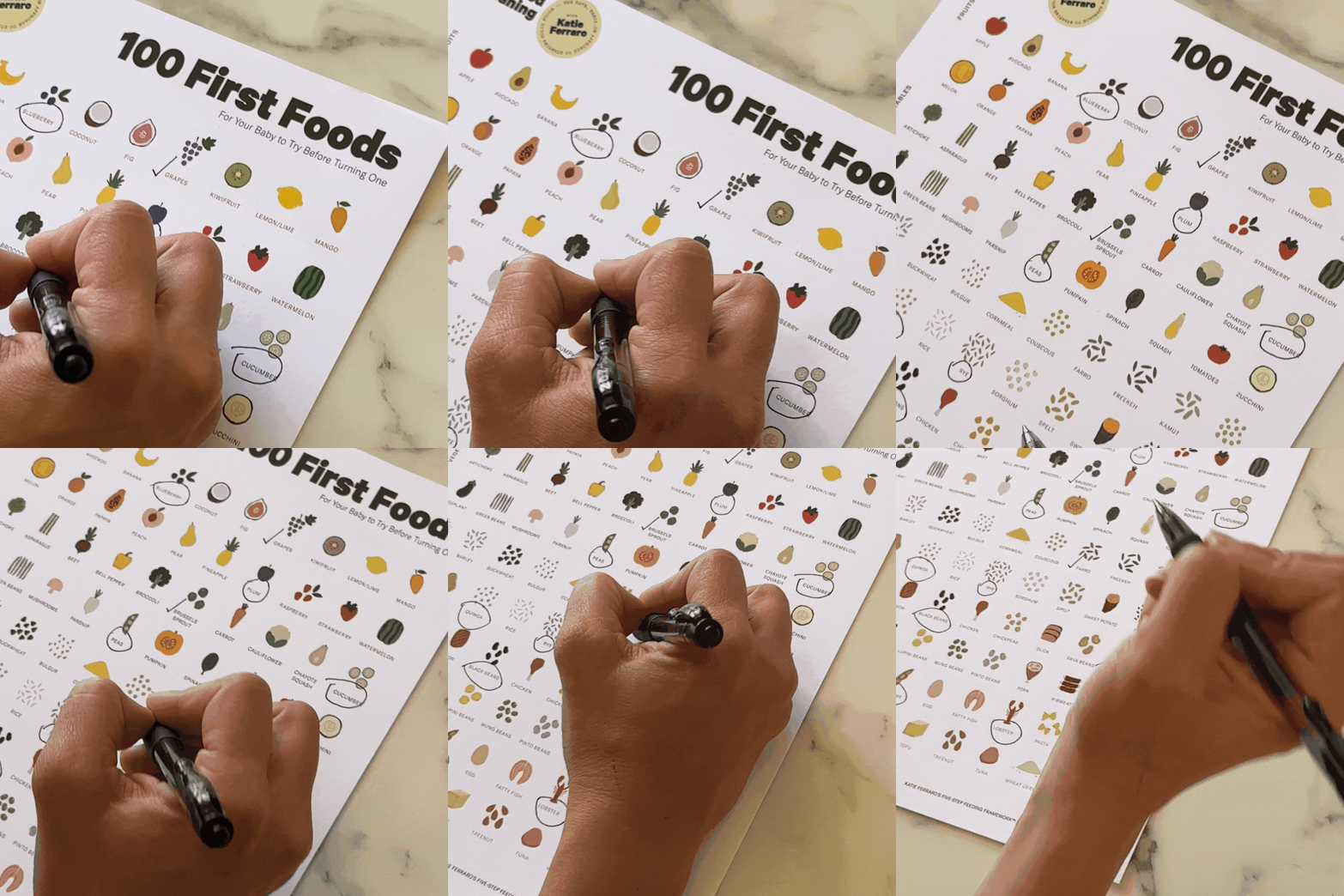
Your baby may need to see a food and touch a food and smell a food and squish that food and bring it to their mouth and spit it out and gag it and try it again, and eventually swallow it on many different opportunities. Okay? That counts. I call an exposure. If you take the effort to make the food and put it in front of your baby, to me, that counts as an exposure. Okay? If you're working through my hundred First Foods list, we do one new food a day, five foods a week, okay? Just like your job, all right? We do a new fruit on Monday, a new vegetable on Tuesday, a starchy food on Wednesday, a protein food on Thursday, and an allergenic food on Friday. If you do five new foods a week, that's 20 foods a month, and in five short months, your baby has eaten a hundred foods, and parents will be like, okay, we did beets, but like my baby wasn't into it that day.

Katie Ferraro (21m 21s):

Does it really count? I'm like, yes, you did beets, you offered 'em, check it off the list. But I know that's not the only time you're doing beets, because after your nap later today, you're gonna re-offer those beets, and then tomorrow you're gonna offer a new starchy food 'cause you're moving on to the next food. But in the second half of that meal, if you're following my program, you're gonna reintroduce the familiar foods from previous days. So beets are gonna work their way back in to the meals those weeks and even in future weeks. So repeated exposures do matter. If you don't yet have a copy of my hundred First Foods list, I give it away to everybody for free on my online masterclass called Baby LED WEANING FOR BEGINNERS. I know you're listening to this, but if you are a visual learner and you wanna see what baby led weaning looks like, the best place to start learning about baby led weaning is that free one hour online video masterclass called Baby led Weaning Board Beginners.

Katie Ferraro (22m 11s):

Everyone who shows up gets a copy of the hundred FIRST FOODS list, and you can get signed up at baby led weaning dot co slash a masterclass. You print out the hundred First Foods list, put it up on your fridge and start knocking those foods off. So what do you do when your baby refuses foods? All right, here's the plan. Step one, stay neutral. Your face matters. Your tone matters. If your baby drops the food or turns her face away from it, you can simply say, all done with that food today? Or, we're all done with this meal and move on. You don't need to be anxious. You don't need to be upset. You don't need to be insulted because you spent 28 minutes roasting that squash, okay? Just be neutral. Your baby's learning from your reaction. If every refusal turns into a big emotional event, that food gets a whole lot more interesting for reasons that have nothing to do with eventual hunger, right?

Katie Ferraro (22m 57s):

'cause we're moving to towards a part where your baby's actually going to start responding to food to make those feelings of hunger go away, but they don't know how to do that early on. Step two, don't remove that food forever. If your baby rejects egg today, we're not canceling egg, okay? You offer it again after the nap or tomorrow or in a different format. Okay? Maybe the fried egg didn't go well, but I've got seven different ways to prepare eggs for phase one of baby led weaning inside of my program. Okay? So you can try different ways if you want to, but I don't want you to feel pressured into having to do that, okay? You can offer eggs in a variety of different ways, okay? You can offer move on to different allergenic foods and come back to egg later if you want to. Okay? Sometimes babies are just rejecting the format and not the particular food.

Katie Ferraro (23m 37s):

Okay? Step three, don't replace every refused food with a preferred food. This is one of the biggest mistakes I see families making. Okay? This is where your baby refuses lentils, but you're like, Ooh, I know they love yogurt. So we're just gonna finish off this meal with yogurt so that the baby's quote unquote, getting enough. Guess what? Babies are really smart and they very quickly become conditioned to sit there and wait for you to bring them their favorite food if you do that every time they reject a new food, okay? So we're not saying that offering foods like yogurt on occasion is not a good idea, but you never wanna offer the same food every meal, and certainly not every day. So keep offering those new foods, one new food a day. But we also use the second half of the meal every 20 minute.

Katie Ferraro (24m 19s):

Every meal's about 20 minutes. The first 10 minutes we offer the new food of the day, the second 10 minutes, we bring back up plate with familiar foods from previous days plus the new food from today. So that way we're moving forward with new foods every day, but continuing to offer familiar foods, okay? And this is all part of my approach to starting solid foods with baby led weaning. I teach about it inside of My program, BABY led weaning with Katie Ferraro. If you want everything in one place that shows you how to make the food safe for your baby's age and stage, and literally walks you through which food to feed your baby every single day, I've got that all lined up for you inside of my program. I've also got a $50 off code if you want to get started today. That's in the description where you're listening to this, and you can check out the program baby led weaning with Katie Ferraro at baby led weaning dot co slash program.

Katie Ferraro (25m 5s):

So step four, I want you to keep your meals moving, all right? Early on, meals don't need to be that long. 15 to 20 minutes is plenty for many babies. If your baby's done, wrap it up and get outta there. Okay? Step five, reintroduce the food in a low pressure rotation. Okay? This is where your system matters. We don't randomly just pick foods willy-nilly, okay? We are following a set approach. If you're using my five step feeding framework, I explained it a moment ago, but we're doing one new fruit, one new vegetable, one new starchy food, one new protein food, and one new allergenic food. Those are the five different food groups on the hundred First Foods list. You're doing one new food a day, five new foods a week, that's 20 foods a month, and in five short months, your baby has achieved those a hundred First Foods before they turn one.

Katie Ferraro (25m 47s):

Alright? So keep in mind that food rejection while starting solid foods is typical. I do wanna mention a few times when it makes sense to check in with your baby's pediatrician or to ask for referral to a feeding specialist if your baby is persistently refusing all solid foods, like if they are not making any progress with texture over time, if they seem distressed at most meals, if there's frequent vomiting, okay? If there's coughing or continual choking concerns, if they're falling off their growth curve, or if you just feel like something is truly not right, please do seek individualized help. You know your baby best, okay? But your action step for this week, I want you to walk away with a quick win is the next time your baby refuses a food that they used to like.

Katie Ferraro (26m 27s):

I want you to say this to yourself. Rejection is information. It is not a final answer. And then do these three things. Stay neutral, keep that food in your rotation and offer it again later, either after a nap later today or tomorrow. And if you can possibly in a slightly different format, that's it. You don't need to chase the baby around with a spoon. You don't need to panic. Look up whether your baby suddenly hates broccoli or is allergic to it, which they certainly are not, and you definitely don't need to abandon that food. Keep in mind that practice makes progress. Your baby is allowed to have days off, but I really would encourage you, do not skip days of starting solid foods, okay? Occasionally families are like, I just can't deal with a new food today.

Katie Ferraro (27m 8s):

And that's perfectly fine. If you're following my hundred First Foods Daily Meal Plan, we do do five new foods a week and then we use the weekend to reintroduce those allergenic foods and get all of the foods from the previous week back into the rotation. So we're kind of taking a break, but then we start again the next Monday with five new foods. And a lot of families say the first eight weeks are the hardest because the baby's not actually eating a ton of food, but hang with it because by the time you get to that week eight, the 40th food, that's when it really all starts to click. And that's when your baby kind of eases into that, what I call phase two of baby led weaning. That's the golden age of baby led weaning, where they really start liking foods, bringing foods to their mouth.

Katie Ferraro (27m 49s):

That's when you're starting to drop a milk feed. That's when you see nutrition from food going up, nutrition from milk going down, that's baby led, weaning, and action. Hang tight, it will happen. But don't stress out if your baby suddenly refuses foods that they used to like 'cause it's not really a big deal. It's actually typical and part of the learning how to eat process. Alright, I'm gonna put some resources for you guys up on the show notes@blwpodcast.com/117. Don't forget to grab a copy of that 100 First Foods list on the baby LED WEANING FOR BEGINNERS for free masterclass. That's at baby led weaning.co/masterclass. If you're ready to get started making all these foods for baby led weaning, come check out My program, Baby led weaning with Katie Ferraro.

Katie Ferraro (28m 29s):

It's everything you need all in one place. That's at baby led weaning.co/program. The $50 off code is in the description.

Airwave Media (28m 35s):

Thank you to our partners at Airwave Media. If you guys like podcasts that feature food and science and using your brain, check out some of the podcasts from Airwave Media. We're online@blwpodcast.com. Thanks so much for listening. I'll see you next time.

Wooga (28m 56s):

Step into the glamorous and dangerous world of the 1920s with June's journey. Follow June Parker, a bold and independent amateur detective as she uncovers clues unravels family secrets, and solves her sister's murder in beautifully crafted, hidden object scenes. But it's not just a mystery. You can design your own island getaway. Enjoy special events and challenges, collect exclusive rewards and much more when you download the Game June's journey. Put your detective skills to the test and download June's journey for free on iOS, Android, or pc.

null

The Program Baby-Led Weaning with Katie Ferraro

A step-by-step digital program for starting solid foods safely and navigating the original 100 FIRST FOODS™ meal plan with baby-led weaning.

  • Baby-led weaning recipes EXPERT-LED, PROVEN APPROACH TO EATING REAL FOOD
  • Video training CONCISE VIDEO TRAININGS TO MASTER BABY-LED WEANING
  • Feeding schedule and meal plans 100 FIRST FOODS DAILY MEAL PLAN WITH FOOD PREP VIDEOS

Baby-Led Weaning for Beginners Free Workshop

Is your baby ready to start solid foods, but you’re not sure where to start? Get ready to give your baby a solid foundation to a lifetime of loving real food…even if you’re feeling overwhelmed or confused about this next stage of infant feeding.

REGISTER FOR FREE WORKSHOP