
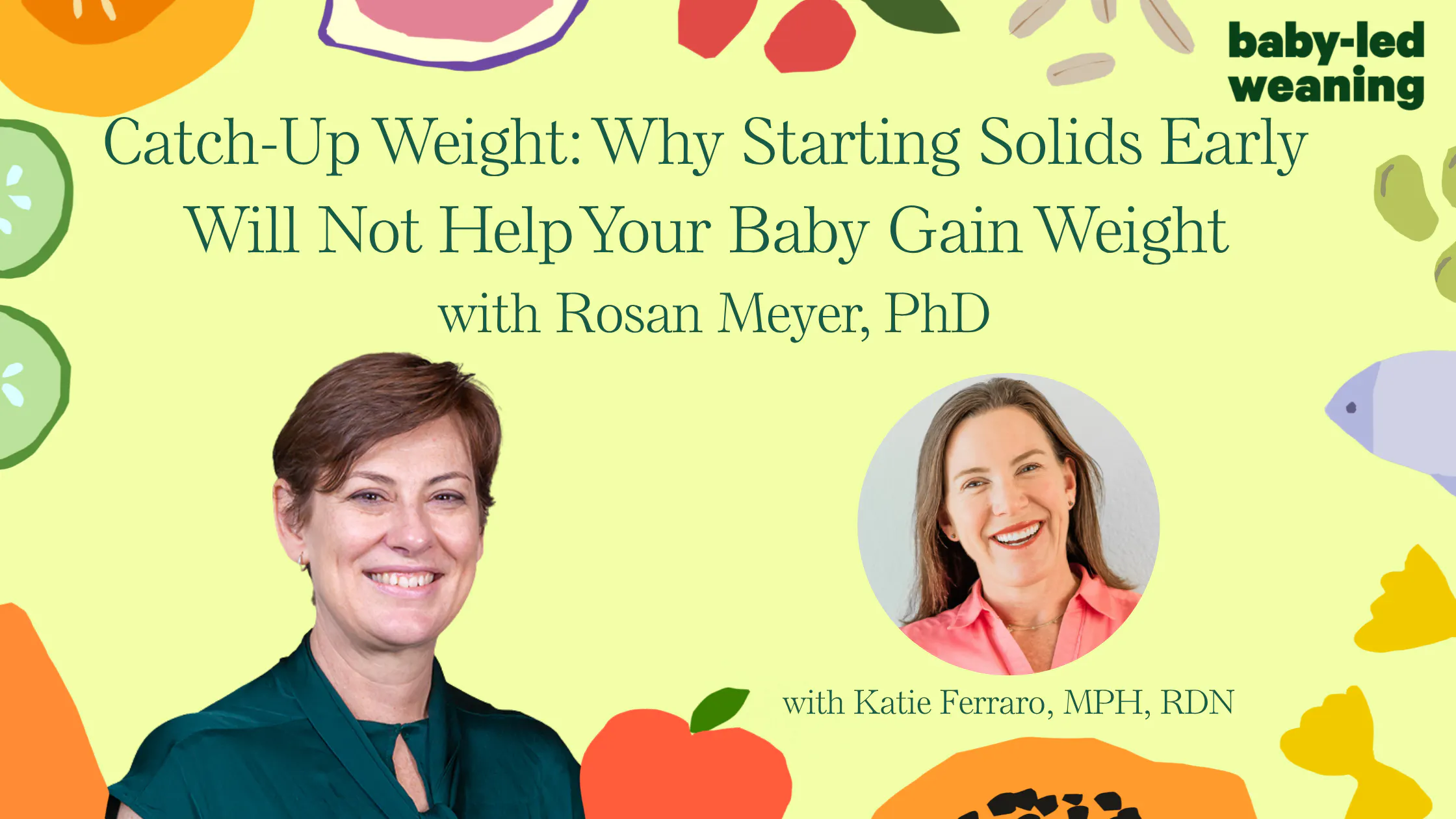
Catch-Up Weight: Why Starting Solids Early Will Not Help Your Baby Gain Weight with Rosan Meyer, PhD
- How to tell the difference between normal growth variation and true growth faltering when you look at your baby’s growth chart
- What catch-up growth really means, and why starting solid foods early is not the right strategy for helping your baby gain weight
- Why shared decision making with your practitioner matters when setting safe, realistic feeding goals for your baby
LISTEN TO THIS EPISODE
Episode Description
If your baby is on the smaller side and you’ve been told to start solid foods early to help your baby gain weight, this episode is for you. That advice can feel scary and confusing, especially if your baby is not showing the signs of readiness to start solid foods yet. In this episode, pediatric dietitian Rosan Meyer, PhD, RD explains why starting solid foods early will not help with catch-up weight, what growth charts are actually telling you, and why milk feeds, not solid foods, are the priority when weight gain is a concern.
About the Guest
- Rosan Meyer, PhD, RD is a pediatric dietitian specializing in pediatric nutrition, food allergy, feeding difficulties, GI issues, and faltering growth.
- She holds an MSc in Pediatric Nutrition and a PhD from Imperial College London and has built an international reputation through her clinical work, teaching, and research in pediatric nutrition.
- Rosan has published extensively, co-authored pediatric nutrition resources for clinicians, and served in leadership roles in international diet and allergy organizations, helping shape best practices in child feeding and growth.
Links from this Episode
- Rosan Meyer’s website for her pediatric nutrition practice Step by Step Kidz Nutrition is here
- You can follow Rosan on Twitter here and Instagram here
- The video about obtaining infant length and height measurements Rosan mentioned in the interview is located here
- Baby-Led Weaning with Katie Ferraro program with the 100 First Foods™ Daily Meal Plan, join here: https://babyledweaning.co/program and save $50 when you sign up using the code BLWPOD50
JOIN NOW AT $50 OFF CODE: BLWPOD50

- Baby-Led Weaning for Beginners free online workshop with 100 First Foods™ list to all attendees, register here: https://babyledweaning.co/baby-led-weaning-for-beginners
Other Episodes Related to This Topic:

Latest Episodes



Whisker (1s):
Today's episode is sponsored by Whisker makers of the Litter Robot, the self-cleaning litter box that helps take one more household chore off your plate because as a mom of seven, I know when you're in the baby phase, you've already got so much cleanup, right? You're wiping the high chair and cleaning sweet potato off the floor, getting food out a tiny little neck folds. And when people would talk about getting a cat, the thing that always stopped me was not the cat, it was the litter, the scooping and the smell and the whole like, wait, I have to touch this everyday situation Because when you have a baby at home, you are already touching enough questionable things. That is why Litter Robot by Whisker makes so much sense for busy families. It automatically cycles after every use so you're not scooping every day or handling waste the way that you would with a traditional litter box. And the big thing for me is the no contact benefit Litter Robot handles the dirty work. So you are not building your day around litter box duty. The Whisker app can also notify you about your unit, like when the litter robot has completed a clean cycle or when the drawer or the litter level needs your attention. I love a system that's quietly doing its job in the background because as parents, like we already have enough tabs open in our brains. Whisker has an automatic litter box model for different types of cat families. So if you have like a single cat home, but it also goes for homes with up to five cats plus bundles that make it really easy to get fully set up while saving money, you can take an additional $50 off bundles with the code Weaning when you shop whisker.com/ Weaning. So that's an additional $50 off bundles using the code Weaning when you shop@whisker.com slash Weaning.
Rosan Meyer (1m 39s):
It worries me If somebody says To catch up growth, you need to start Solids and Growth Center is not there to tell you what a growth center is just there to say for your individual child, where are you? And I'm going to follow you there.
Katie Ferraro (1m 54s):
Hey there, I'm Katie Ferraro, registered dietitian, college nutrition professor and mom of seven specializing in baby led Weaning. Here on the Baby led weaning with Katie Ferraro podcast. I help you strip out all of the noise and nonsense about feeding, giving you the confidence and knowledge you need to give your baby a safe start to solid foods using baby led weaning. Do you ever feel stressed out when they're weighing your baby at the doctor and you're like, oh my gosh, are they gonna be on the growth curve or fall off the growth curve? And sometimes babies have channel surfing right where they shift around on their growth curve. And for babies who are a bit on the smaller side, one thing that I hear parents really stressing out about is the advice they sometimes get to start solid foods early to help their baby with catch Up Weight.
Katie Ferraro (2m 46s):
If this sounds familiar, this episode is for you. Okay? That kind of advice can feel really stressful. It can feel judgy, okay? Especially if your baby's not showing the signs of readiness to eat or to start solid foods safely, okay? Because starting solid foods early is not how babies are supposed to gain or get their catch Up Weight. And my guest today is gonna make you feel better and she is going to explain why. So my guest today is Rosan Meyer. She is amazing. She's a pediatric dietician. She is a researcher. She specializes in growth, faltering and feeding difficulties, pediatric nutrition and food allergy. I have learned so much from Roan over the years.
Katie Ferraro (3m 26s):
I take all of her courses, all of her workshops, any additional training she's providing. Boom. I'm first in line because Rosan, she's like the growth chart guru and she brings this really unique perspective 'cause she works both in clinical practice but also in research. So she's gonna help families interpret the research that's out there. She contributes like the evidence-based side of it to the actual daily practice. So we actually recorded this particular conversation a while back, but I wanted to re-release it because I've had this kind of increase in parents in my program asking questions about catch Up Weight. And if your baby's a tad on the salt moler side and you're feeling this pressure to start solid foods early, you have to hear Anne's message.
Katie Ferraro (4m 9s):
Okay? If you are getting ready to start solid foods and you're looking for a done for you solution, I've got a program baby led weaning with Katie Ferraro that shows you everything all in one place on how to make all of the foods safe for your baby, what food to offer, what day in what order. Check out the baby led weaning with Katie Ferraro program when your baby's ready to start solid foods. I do have a discount code wherever you're listening to or watching this video if you want to get started with real food. But with no further ado, I want to bring on Rosan Meyer who's gonna be talking about catch Up Weight and why starting solid foods early will not help your baby gain weight. Here's Rosan Meyer.
Rosan Meyer (4m 52s):
Thank you for having me Katie.
Katie Ferraro (4m 54s):
I am so excited for the opportunity to interview. I have so many questions, but before we get started, could you just tell us a little bit about yourself and your background, what you do and how you got to where you are at today?
Rosan Meyer (5m 4s):
Absolutely Katie. I have a bit of a mix of a background. I'm not sure if you can understand from my accent, but I'm originally from South Africa. I moved over to the UK in 1996 and since then I now live part-time in France, still practice in the UK. I specialized in pediatrics in the UK, did my MSC as well as my PhD. All of it in pediatrics. And my research area is very much though I do gastro And I do allergy, but it's very much around nutritional status. So growth, how growth interacts with vitamins and minerals, feeding difficulties because all of that interacts. So it's an area that I find fascinating and it's an area I can see the challenge for healthcare professionals, but in particular for parents as well.
Katie Ferraro (5m 49s):
And what do you do in your day to day practice? I know you are doing a virtual practice at this point in pediatric nutrition.
Rosan Meyer (5m 54s):
Absolutely. So I specialize, as I said before, feeding difficulties, gastroenterology, food allergy and growth. Faltering is really my specialty. So I really struggle the area of when parents come to me and saying my child is not growing well or when a doctor refers for a child that's not growing well to help make signs or a diagnosis more real and provide parents with advice of how to rectify that. And
Katie Ferraro (6m 20s):
You mentioned the term growth faltering. So from a terminology standpoint, could you set us straight on, And I know it's kind of a loaded question, growth faltering, failure to thrive, catch Up Weight, these terms get thrown around so much oftentimes in the lay community as well. And I think it's important for parents to understand that they really do have clinical underlying diagnostic criteria.
Rosan Meyer (6m 37s):
Great question. So I'm going to start with growth faltering and failure to thrive. Growth faltering and failure to thrive are interchangeable. What you'll see is that within Europe we use more growth faltering in the US it's more failure to thrive. And the reason we've moved away from failure to thrive within Europe and in particular in the UK is that failure to thrive implies that there's a failure from a parenting perspective. And we felt that that terminology failure is not a positive terminology. So we've really switched away from using a failure to thrive to growth faltering, but actually they are interchangeable. Growth faltering or failure to thrive. I always explain to parents is the journey downwards?
Rosan Meyer (7m 21s):
Okay, so that means you have your growth charts and your Pediatric dietitian or your dietician is supposed to as you, your child grows track you on your growth charts. And the crossing downwards in terms of centiles is when you have growth faltering. Now this is where it comes because in the US you have slightly different growth charts than what you have in the UK. So some work work with Z scores, some work with standard deviations, some work with centile drops. So generally a growth faltering or failure to thrive is seen over at least a month period of time, at least a two centile drops. And the reason I'm saying over a period of time you can have a child today that for five days has diarrhea, loses half a pound or more than a pound pound and that would not be seen as gross faltering because we know once they start eating, so it needs to be over time.
Rosan Meyer (8m 14s):
Conversely, malnutrition actually is very well defined by the World Health Organization. So whilst faltering growth is the journey downwards, malnutrition is I am already down. Okay, so I'm already down at the cutoff, the WHO is very clear and that's based on Z scores with the WHO growth charts at below minus two standard deviation, Z score weight for age, weight for height and height for age. So you do not use the term malnutrition unless you've reached that point just dropping centar, that's faltering growth or failure to thrive.
Katie Ferraro (8m 50s):
And so parents like the term catchup growth, I know that's also a very not controversial term, but it is a term that gets misused. Pediatricians will tell parents, oh your baby needs to start solids early for catch Up Weight. And that puts a lot of pressure on parents that think something is wrong with their child and then they should be using food to fix it. How should we respond when parents are given that instruction? And also loaded question, but what is catch Up Weight?
Rosan Meyer (9m 15s):
Yes, Katie, what an amazing question to ask catch up growth. In order to understand that you actually have to understand what does normal growth for that individual child, okay, so first of all is that you have normal growth and normal growth. And I always say this to parents, every child will drop over the course of the first two, three years of life, they will have periods where their weight or their length drops that is actually normal. Although a center line looks very smooth when you look at the raw data you will see kind of goes up and down. So if we are saying that catch up, then you need to say what do you catch up to?
Rosan Meyer (9m 57s):
So what is normal for that child? Now a lot of parents say to me, but what is normal for that child? You cannot make an assessment on what is normal based on weight only You have to take length and length is done up to two years of age and then it's height and head circumference as well. So if you've got a child for example, that is, I'm going to use the 50th centile because I know the US you've got a 50th centile as well and they've dropped one centile and you've said to be a bit Roseanne, this child has always been one sandal lower in terms of length. Then I'm going to say to you, Katie, well you do not need to catch up because actually you are now matching exactly where the height is at the moment.
Rosan Meyer (10m 40s):
So the term catch up needs to be used, correct the term catch up for the individual child as you catch up to what we are expecting, you need to normally grow. And that's where it becomes quite confusing because for us as healthcare professionals, we had a pre-discussion prior to this podcast we discussed, said to you, I had four hours discussion yesterday academically to say what is catch up? So you need somebody that really understands the genetics. So I always take the parent's height, I calculate the mid parental height. You don't look at your individual points. For me as a dietician, you can't just go, what is your length? What is your weight today? You go and take a thro birth, you go and take the length from birth and saying I think this is where you need to be.
Rosan Meyer (11m 27s):
Okay. And then the next aspect is you don't need to do catch up if you've not got a faltering growth or failure to thrive. If you've come to me and saying, Roseanne, the weight has just dropped slightly, then I would say to you, all we need to do is we monitor you now because what I really am concerned about and I'm sure Katie you're aware of is this pressure on catch up and pushing nutrients. And when the child actually does not need it, it metabolically, we know that if a child then becomes overweight it at an early stage, it actually predisposes them to syndrome X in later life obesity, T diabetes, cardiovascular disease. So my advice to parents is when somebody gives you advice and saying you need to catch up, the question is first going to be why are you asking me to do this?
Rosan Meyer (12m 14s):
Show me on the growth chart and tell me where my child needs to be. Because if it's just a centile line drop And I would say to you, I would rather say let's monitor and weigh in a month's time, measure in a month's time again and monitor. Second question is going to be, is it actually appropriate for me to catch up? Now is this just a normal, has my child had a cough or a cold? Because that can actually also explain. So it can be just a natural process. So I'm very reluctant to use term catch up unless there's actually filtering growth. And if there's actual faltering growth, then the term catch up is you catch up to where a child was before not too higher to where they were before.
KiwiCo (12m 58s):
Hey, we're gonna take a quick break but I'll be right back. Can I be honest? That summer kind of freaks me out and it's primarily because my kids are home from school, which I love. But also I'm still trying to work and suddenly the days seem so long, camps are not long enough and they're super expensive, especially with seven kids. So I'm constantly trying to figure out what can they do that's actually fun that will keep them busy and that will not turn into like a screen time free for all. And that is why I've been very grateful for KiwiCo and their summer adventure series. So KiwiCo provides hands-on fun educational kits that come right to your door. So when you give a KiwiCo crate or a kit or a gift set, you are not just giving a toy, you're giving kids the tools to create their own fun. And if you have little kids who are curious, you've got to check out the KiwiCo make and play kit for kids age two to three years old. I love watching toddlers get totally locked in, right? They start experimenting, they get stuck for a second, then they try again without asking for help. And when it finally works they have that proud little I did it moment and then they wanna keep playing. It's the best kind of busy because it feels like play. But they're learning and creating with the KiwiCo Summer Adventure Series kids get six ands on projects and they get these kits that come to them over six weeks. The themes are so fun. There's Ocean Games, neighborhood fun, alphabet play, little driver space search, my personal favorite kitchen play. So if you want to build the best summer ever with KiwiCo, get $10 off your summer adventure series at KiwiCo.com/summer promo code Weaning, that's kiwico.com/summer promo code Weaning for $10 off.
Katie Ferraro (14m 52s):
And let's talk about the inherent inaccuracies in measurement, at least I don't know how it's in the UK but in the United States the way we obtain height is laughable. They don't use a stadiometer, they push a baby down on the measurement table who's cold. So they're crying, they put a pen underneath the foot, they put a pen line over the head, they measure the distance in between. And if that baby squirms or quiches up, you're off by an inch or two, which throws parents into like a terrible downward spiral because it looks like the baby is falling off the growth curve. And oftentimes it's just a matter of inaccurate measurement. I always ask parents that, you know, be an advocate for your baby. I am a little bit anal but I will measure my babies and weigh them before I go to the doctor just so I know what I think the baseline is.
Katie Ferraro (15m 32s):
Because if they plot wrong data, you look like a failure as the parent when in fact it might not even really be a problem.
Rosan Meyer (15m 38s):
Absolutely. And to be honest, it's actually Katie's so reassuring to hear that it's not only happening in the UK but it's happening in the US as well. So if you look at the data from the uk, the length measurements are in fact in primary care so bad that at the moment they are saying don't do it if you do not know how to do it accurately. And it is for me, of course as a dietician, this is the wrong way about going about it. I'm saying yeah, train everybody, not don't say because you can't interpret a weight unless you've got a length. Because as you, you talk to me about catch up growth, I have so many children are sent to me that are sent because they are on the highest S where if they were measured correctly they would see that their length is also on the higher percentiles.
Rosan Meyer (16m 23s):
You are a hundred percent correct. So I actually, I have produced a video now during the pandemic for parents to do the measurements accurately at home. And I always say to them, if you've got a measurement which looks like oh my gosh, this looks like you've dropped, then I always say no we are not going to take this measurement that could be an outlier. We are going to remeasure. So I don't if there's a measurement that has just kind of dropped suddenly. I always say to parents, we are going to remeasure And I always go, if I get a referral away saying this child, the length has dropped quite dramatically. I always say the first step is we are re measuring it. And that is really important for parents. You have to advocate And I think parents play a crucial role also to help healthcare staff.
Rosan Meyer (17m 8s):
Katie. You know, you can't take a length measurement by yourself, you have to have two people. So I always say to parents, read a little bit up on length measurements And I normally give them, I said and tell the, when you go and have a measurement done by a healthcare professional saying I'm here, I can do the foot side or I do the head side And I can, you know, I can tilt the head and all of those. The other problem I really have is that lying down and standing up, I'm sure you've got the same problem that lying down often we do it only until one year of age and then suddenly when they start walking they need to be standing up where in fact our growth charts is up till two, it's supine and from two it's standing up. So yes, absolutely.
Rosan Meyer (17m 49s):
And you know, if I may say so we are taking it so seriously, we are now have developed with one of the University of Winchester here, an virtual online training course for healthcare professionals only just on gross measurements, nothing else. Wow,
Katie Ferraro (18m 4s):
That's amazing because in the United States it's the medical assistants who do it in the pediatrician's office who are completely overwhelmed. They do everything from the finger stick to the temperatures to the, I mean they do it all. And so, you know, oftentimes they're just in such a hurry. I think half the time parents don't even realize what just happened was they just took a length that may be potentially inaccurate. And so I appreciate what you're saying to be an advocate and don't be scared to speak up. I'm sorry, can I please request, I mean I literally have asked for like three different finger sticks when the hemoglobin comes back low on my kids. 'cause I'm like, sorry, I saw the way you did it. Like, you know, not to be disparaging, but if we do have inaccurate measurements, all of the data becomes inaccurate. That becomes a part of your child's medical record. And as a parent to see failure to thrive is like, 'cause we still use that term here, which I agree with you is is it makes you feel awful as a parent is totally preventable.
Katie Ferraro (18m 51s):
So can we speak for a second about premature babies? I know as a mom I had quadruplets, I carried to 34 weeks. They were all born between two and three pounds. So there's six weeks premature. They always tracked at the 10th to 15 percentile and wait for length or weight for age. And even when we started solids, we waited till they were six months adjusted plus showing the other signs of readiness to feed. But you know, it took one of my quads an additional six weeks. So he was almost nine months chronological age before he really even began eating. And I feel like without a nutrition background I would've been so stressed about that and thinking, gosh he's only the 10th percentile, he's not eating. I have other friends with nine month old babies that eat like full meals. How do you speak to parents who are concerned about their child's weight because they were premature and are now moving into the era where it's time to start solid foods?
Rosan Meyer (19m 37s):
Again, a wonderful question I think. I think the first aspect is when we talked about catch up and growth, there's actually much more data on premature babies in regards to growth rates. So that, you know, has switched on neonatologists and a dietician can really help you better from that. But I wanna just reset. I normally, my discussion starts with what is what you want to achieve? Because I think often my discussion is around expectations that are not viable because most parents that have preterm infants, they want their child to be chubby and big. Like, do you know my friend's baby? That's not going to be achievable and that's also not healthy for a preterm child.
Rosan Meyer (20m 17s):
So in a preterm infants the evidence in terms of too fast catchup and syndrome X is extremely strong. So I first of all have a discussion of what you're expecting and maybe that what you want to do have them shift over and have these little fact roles is not actually in a viable achievable goal. And the second aspect is that's also not what you want to have. I get very concerned if I have a preterm child that moves too fast up on the, so that's the first thing. The second aspect, Katie, you know, I don't know how long you've been working in the nutrition field, but I started off beginning of the nineties and when all of these WHO guidelines, those guidelines and those guidelines, you basically looked at the child and said this child is ready.
Rosan Meyer (21m 2s):
You know, we'll start with solids. Yeah. And another child is not ready. So the evidence that we've got really is as you know, you think about preterm children saying, okay, they were born preterm. We think about the gastrointestinal tract, we think about the physiology and we know at a certain age the physiology as they were born preterm would be ready to receive foods. But what's happening in the pathophysiology, what's happening with the mouth might not correlate. So the way I work it And I optimize, whether that's breastfeeding, where to fortify breast milk or whether that is, you know, formula feeding. I make sure iron vitamins go and optimally and then I calm down the parents saying, look, forcing a child, now a preterm child that's not ready to feed is not going to be the right way forward.
Rosan Meyer (21m 50s):
It might be that we agree let's say from six months corrected age, not that the child could take some lip swipes, you know, and they enjoy that. But because the percentage of feeding difficulties as you know, is so much higher in preterm infants because of invasive medical procedures, whether that's oxygen, yeah, nasal prongs, they are sensory so much aware we have to be really careful in forcing these preterm infants to have food. Because carry wise, protein wise I can get much more, let me tell you from my breast milk and from my, you know, formula milks with the right addition, your protein energy ratios.
Katie Ferraro (22m 30s):
Could you speak a little bit about how starting solids too early has the potential to displace the important nutrition from breast milk or formula on top of the fact that physiologically babies aren't ready to eat anything except that not only is it dangerous, but nutritionally what's this doing to babies if we start too early?
Rosan Meyer (22m 45s):
Yeah, I see that now quite a lot and It worries me If somebody says to catch up growth, you need to start solids. So there are a couple of things you've already highlighted the oral motor skills that goes without saying head control, all of that, which actually means that it can be dangerous. But I think there are two aspects from a nutritional perspective that worry me. The first one, if I just use numbers. So breast milk has got around 70 kilo calories. If you say four, the that rich hind milk and your formulas, unless you took a take an energy dense formula, it's very similar. But when you start with complimentary foods, you start with vegetables, fruit, you know your porridges and those, they are ly not very energy dense, but babies stomach capacity are low.
Rosan Meyer (23m 31s):
So therefore what you're doing is even if you say, I'm just going to give a small amount, number one, you're giving a small amount for what benefit for 10, 15 kilo calories and three to four teaspoons. If I could have had, you know, an ounce more in terms of formula or in terms of breast milk, so calorie protein wise, I would get much more. So that's a wrong argument to say okay, I'm going to use solid smell for ketchup. The next argument, so let's say your Pediatric dietitian actually, or forces you I want to say says actually you need to start with the energy dense foods in a non-allergic child that might be yogurts Jesus, you know, anything that has got fats, protein, and calories.
Rosan Meyer (24m 13s):
Then my second concern is that breast milk is the ideal source of nutrition. So when we measure what you wanna give, you say breast milk has got 6% of energy as protein. The evidence that we've got at the moment is you, if you force a child to give too high a protein too early on, it actually starts a cascade of metabolic responses within the child that increases the risk of obesity in later life. Life. So although you might not see your child at that stage, you know growing really fast, it actually sets a metabolic cascade of so high protein diets. And I think per se, I want to just say very, very high protein diets very early on, it's really not recommended for babies
Katie Ferraro (24m 57s):
On top of the fact that it's an asinine recommendation because babies can't actually even physiologically eat those foods safely before they are actually ready.
Rosan Meyer (25m 8s):
Like I said, you know from an oral motor, you know from all of those kind of things, you know there are two other from a just purely dietetic, you know, you are displacing food and even if you were then saying, okay, I'm using energy dance, then what are you giving? Therefore, you know, if they were supposed to have breast milk, what is the consequence of the type of pressure you're putting physiologically on the child?
Katie Ferraro (25m 31s):
So Roseanne, what do you recommend to parents who are getting this pressure? Let's just make up a case study. Babies born maybe three to four weeks. Premature has always been 10 to 15 percentile, weight for length, weight for age. And the pediatric dietitian says to the mom's face, oh, four month appointment you should start solid food so your baby can catch Up Weight. What language should parents use to give the correct response? It's not being disrespectful, but to protect their child.
Rosan Meyer (25m 56s):
I'm a firm believer, Katie, And I think most many healthcare professionals now is in the triangular medical service. That means a healthcare professional does not talk down to a parent, but that there is a shared decision making and part of the triangle. So you've got the healthcare professional, you've got parents and you've got the internet.
Katie Ferraro (26m 15s):
I did not think the third one you were gonna say was the internet. I'm sorry. I love it
Rosan Meyer (26m 19s):
Honestly because that means we now and And I think it's wonderful, we now have parents that come informed to a consultation. So I always say to parents, I think that with this healthcare model, you want to be able to say, look, I want you to explain because a healthcare professional that understands the physiology of catchup should be able to explain. So the explanation should be, what do you want me to catch up? Because how much have I dropped? Where do you actually want me to catch up to? Because that's where the length is. We're taking this hypothetical case, this is where the head circumference are you expecting something that is not physiologically right?
Rosan Meyer (27m 1s):
And my child is only four months, still hasn't got head control, shows no interest in food. And I know that if we are now doing this, there is a risk of feeding difficulties. What are the long-term consequences? So I would really say to the healthcare professional, explain to me why. And I think the why is an important, so therefore the healthcare professional has to in their head saying, okay, this parent actually understands and really I need to understand why. Second thing is, if There was a reasonable a reason why to, you need to say where do you want me to catch up? Then the third thing is, is my child actually safe to have it? And the last thing is because you know Katie, I have been in situations and they are clinical situation where I wanna say to you, I've got children that are from a gastrointestinal perspective, so severely unwell that we don't tolerate any feeds.
Rosan Meyer (27m 51s):
For example, the only way we can do is hypoallergenic, Weaning, you know, to kind of get some nutrients in. But in those cases, I always say to parents ask, when are you going to see me again? Yeah, you cannot make a recommendation without saying, I am going to monitor you and see that you're okay. So once you are reassured that that is in fact for your child the right decision, And it often is not, but you know, let's say you've been reassured it's for your child, then you wanna know when am I going to be seen again to monitor that this is still for my child the right decision.
Firestone (28m 25s):
Hey, we're gonna take a quick break, but I'll be right back. Real value shows up in reliability. You don't have to second guess. Like a set of Firestone, all season tires, they're designed to deliver confidence, inspiring, wet weather traction and a quieter ride no matter the road season after season. Firestone all season tires for durability you can count on just like people count on you. Firestone always dependable since 1900.
Katie Ferraro (29m 7s):
Roseanne, I would love to do like a whole separate interview on growth charts because I think they're really confusing but also very fascinating and can be a wonderful aid if they're used properly and they can be horribly anxiety inducing if they're used incorrectly.
Rosan Meyer (29m 19s):
Absolutely.
Katie Ferraro (29m 19s):
But I wanna ask real quick, because parents don't always understand the concept of percentile and we live in this like hyper competitive environment where parents will think, oh my baby's only at the 15th or 20th percentile implying that the gold standard is a hundred And I like no, if your baby's always tracked at that, yeah, and you're staying on that, that's an indicator that you guys are doing a great job and parents feel like that the goal is a hundred. So could you just break down how the centile actually works on a growth chart?
Rosan Meyer (29m 45s):
Absolutely. So the US also, like for us in the UK for your young children, you've switched over to using your WHO, although you've got the still same percentile. So I first wanna say it's a growth reference. Okay, so they are breastfed children. And secondly, And I think that's also very important because you also have a very, very big multicultural society. I always say to people, I have my family's from India, from Pakistan who say to me, but you can't use your UK growth charts. And I'm sure the same because you know, my child is here on the 15th center and if I used an Indian growth chart, no, actually no. It is the current growth chart for our children from the WHA that have have been used by the us, have got a population that represents developed developing countries, Asian, African, you know, all of those populations.
Rosan Meyer (30m 35s):
So if we are looking at the growth chart, your 50th centile, And I have to bring in a bit of statistics here. So that means if you've got a nice little bell curve, so that means the middle of it means 50% of your population grows along that if you go your bail kind of curve comes to the left And it comes to the right. So you can say, say, okay, 25% start grow at at the lowest center below the 50th and 25 go above the 25th center. And then you're going to where you go 200 on the one side and to zero on the other side. And that means that a very small percentage in the population grow at that center. That does not mean exactly like you said, that your aim is to be on the 50th or be on the hundred percent center.
Rosan Meyer (31m 20s):
The aim is to be where genetically, where nutritionally you started off your journey, where you moving up to whether that's on the 50th center, but my child has always gone on the 50th center, all the growth chart is saying that within a big population it would be only X percentage, a lower percentage growth on that percentile. And that's all the growth percentile. A growth center is not there to tell you what a growth center is just there to say for your individual chart, where are you? And I'm going to follow you there. And you've made a very important point that for pre-term child they might be on the 10th center, but they're growing beautifully on the 10th center.
Rosan Meyer (32m 0s):
That's fine. I know I have so many sessions where I hand out tissues because the growth chart has caused so much pressure. And yes, I'd love to do a separate session because the growth charts, they are wonderfully fascinating. But I find if they are used negatively to actually show it, and I'll come back to the terminology of failure, you know, failing to thrive, where that's really not what a growth chart is not showing any failure, it just shows if there's faltering.
Katie Ferraro (32m 31s):
Oh, I love that. I think you've given a lot of parents, a lot of, yeah, sense of calm and peace that it's, this is nothing that you're doing wrong. Absolutely. That you may be going in the wrong direction, but it's not the end point.
Rosan Meyer (32m 42s):
And going in the wrong direction sometimes just means I'm holding your hand, we are just going to monitor you and we don't need to interact. Now I'm just looking, I'm just monitoring. And that's such an important message for parents to say that for me, a growth chart is I'm holding your hand, I'm there for you. And that's the way, when do I need help? And that's all that it is, is there for
Katie Ferraro (33m 4s):
After college, I was a Peace Corps volunteer in Nepal. So I lived in a rural community for two and a half years And I worked in maternal and child health and the growth chart was maybe the one piece of paper or documentation in addition to a birth certificate that the family would have. And one thing I loved was the terminology that we learned to use in the local language was to describe it as the path to health and just explaining that this is the path that you are on. And right now maybe we went off the path, but we can do this and that and the other thing to get back on the path. That's that always stayed with me,
Rosan Meyer (33m 33s):
You know? And sometimes, And I I wanna also say during this lockdown period, food insecurity has grown hugely And I know once that might necessarily not affect, you know, breastfed infant that's just starting with solids. Certainly want to say that this pathway for us as healthcare professionals is an important pathway also to make sure that the family is safe and that you get the help. Because sometimes I certainly am finding that with food insecurity questions, a lot of time I see it first in a growth chart where I can say, are you okay? And I wanna say that again to parents, it's this path, if I may use your term, you might have just kind of dropped a little bit from the path, but we are here to help whether that is with supporting you with the right advice, but it might just be also I'm monitoring you.
Katie Ferraro (34m 20s):
Well, Roseanne, thank you so much for all of your insightful guidance for parents And I think reassuring words and then also bringing your expertise into around which I think sometimes a lot of times parents don't realize, oh, maybe my doctor doesn't know everything about this. So I loved your mention of the triangulation And I really appreciate that you mentioned the internet as a valuable resource for parents. I mean, parents say, I learned about how to feed my babies from your podcast or your Instagram. We're not supplanting your primary care practitioner, we're just augmenting the information that's out there. So tell our audience, please, where can we go to learn more about the work that you do?
Rosan Meyer (34m 55s):
That's very kind of unit, I want to just say any healthcare professional that tells you they know everything is not a healthcare professional because health data changes every year And I can never stay up to date. And I appreciate if parents saying, Roseanne, I've read this. So I, of course I can't tell myself, I say know it all, but I have my own website. I run on step by step kids nutrition, I also have Instagram accounts. If you look at Roseanne, pediatric dietician, you'll find me there. I am very much about using food. For me, food is the most wonderful nutrient you can get. And I want to always produce recipes and produce ideas that parents can at home adjust for their families.
Rosan Meyer (35m 39s):
As I said, I primarily work in clinical nutrition, so gastro and allergy. So I do a lot of free from foods, but it's about seeing what you've got at home and how you can make something that's really nutritious for your baby. And
Katie Ferraro (35m 52s):
Can I ask if it would be possible to share the video on how to do the measurement at home that you mentioned? Is that completed?
Rosan Meyer (35m 58s):
You can find that already. Okay. I'll send it to you. You can already find that. The only thing I want to say to you is I do the measurements, but I also give the advice on how to clot. So the plotting, I just wanna say for all of your listeners in the US the plotting is on UK growth charts. So measurement all is very sane based on WHO methods. But the plotting, if it looks slightly different to what you've got, that's the only deviation from what you've got. But I wanna end up in saying it's not just the Pediatric dietitian, the dietician's role to plot. I know somehow people kind of think, I can't touch this chart. I always say to parents, you can, you can touch it. You can look at it because that way we find mistakes.
Katie Ferraro (36m 39s):
Well, thank you so much. This has been a fabulous conversation. I really appreciate your time.
Rosan Meyer (36m 43s):
Big pleasure.
Katie Ferraro (36m 45s):
Well, I hope you guys enjoyed that interview with Rosan Meyer. She is one of my favorite people in the infant feeding space. Such a wealth of knowledge, but so amazing at translating the research into practical information that families can use. So she's a researcher that also works with families and knows how to talk to them. That is a rare breed, my friends, I'm gonna put all the resources that Roseanne mentioned in the show notes for this episode, which you can find@bwpodcast.com/110. And If you are just getting ready to think about starting solid foods for babies or your baby and you wanna learn about baby led weaning, the best place to get started is my free online masterclass. It's called BABY-LED WEANING FOR BEGINNERS.
Katie Ferraro (37m 26s):
It's a one hour online video workshop where I show you everything you need to know to give a safe start to solid foods those first few days. Plus, everybody on this free masterclass gets a copy of my original 100 First Foods list. You can sign up and take the masterclass right now, later today when your baby naps tomorrow, whatever works for your schedule. Sign up at baby led weaning dot co slash masterclass. Thank you again for listening. Thank you to our partners at Airwave Media. 'cause if you like podcasts that feature food and science and use in your brain, check out some of the podcasts from Airwave Media or online@blwpodcast.com. Thank you so much for listening. I'll see you next time. Bye now.
Columbia (38m 11s):
You can't reason with the sun. Trust us. We've tried this summer. It's time to put that angry ball of fire on mute. Columbia's Omnish Shade technology is engineered to protect you from the sun's harsh rays that can burn and damage your skin. The sun is relentless, but so is our gear. Level up your summer@columbia.com to spend more time outside and less time slathering on Allo lotion. You're welcome. Columbia engineered for whatever.

The Program Baby-Led Weaning with Katie Ferraro
A step-by-step digital program for starting solid foods safely and navigating the original 100 FIRST FOODS™ meal plan with baby-led weaning.
 EXPERT-LED, PROVEN APPROACH TO EATING REAL FOOD
 CONCISE VIDEO TRAININGS TO MASTER BABY-LED WEANING
 100 FIRST FOODS DAILY MEAL PLAN WITH FOOD PREP VIDEOS
Baby-Led Weaning for Beginners Free Workshop
Is your baby ready to start solid foods, but you’re not sure where to start? Get ready to give your baby a solid foundation to a lifetime of loving real food…even if you’re feeling overwhelmed or confused about this next stage of infant feeding.
Get baby-led weaning recipes and tips delivered to your email inbox.