
3 Signs that BLW is Going Well for Your Baby
- How timing the introduction of solids foods does not depend only of the age of the baby but also on their stage of development
- The importance of allowing a baby to drive the feeding experience by responding to foods with a “positive tilt”
- Why offering a wide variety of foods to babies helps to increase the acceptance and decreases the struggles of picky eating
LISTEN TO THIS EPISODE
Episode Description
Looking for ways to know if baby-led weaning is going well for your baby? Feeling like you’re about to throw in the towel because you don’t know if it is working? In this episode I am going to redefine what a win and a success is when doing BLW. So do not stress because you will learn about three clear signs that you and your baby are successfully navigating your blw journey.
Links from This Episode
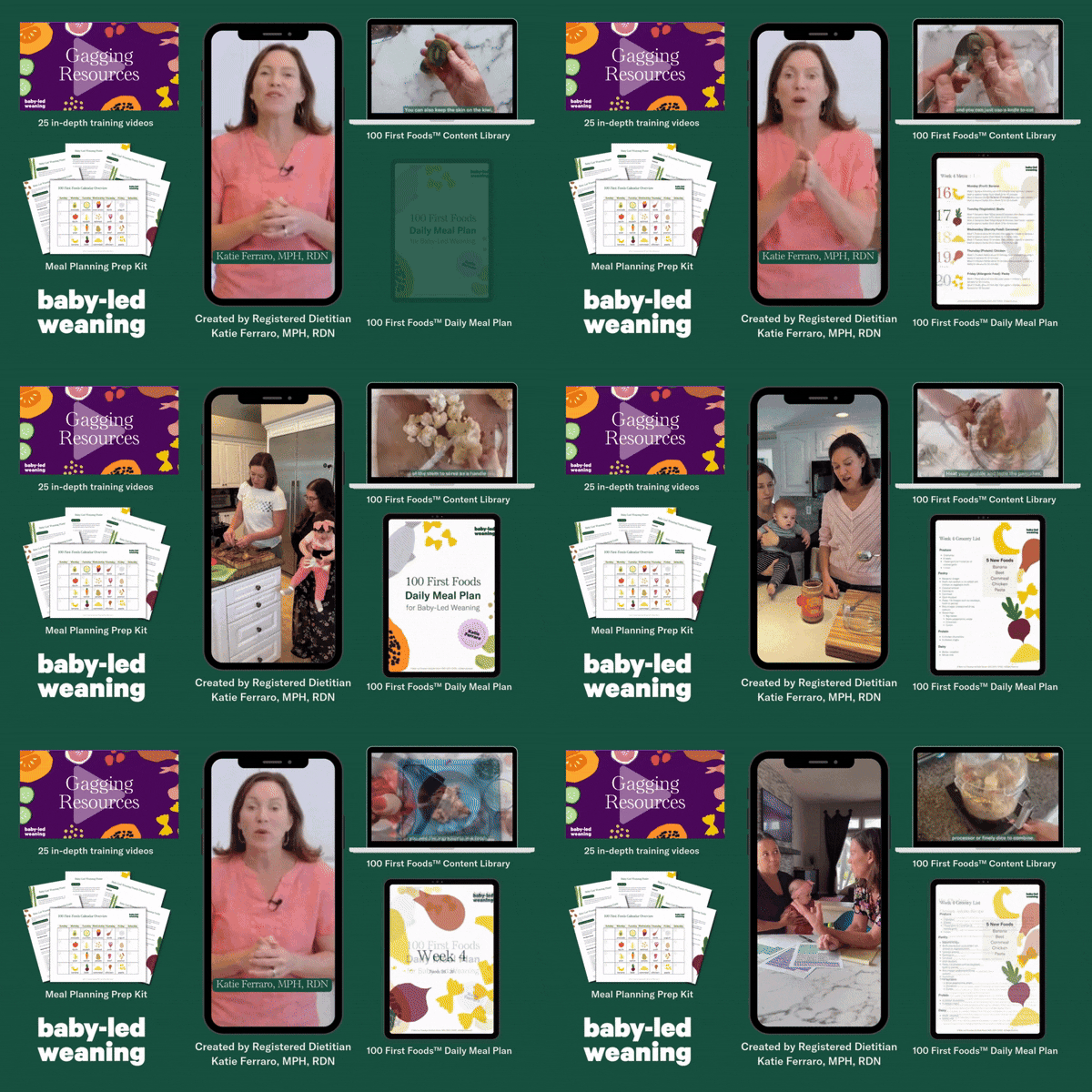
- Baby-Led Weaning with Katie Ferraro program with the 100 First Foods™ Daily Meal Plan, join here: https://babyledweaning.co/program
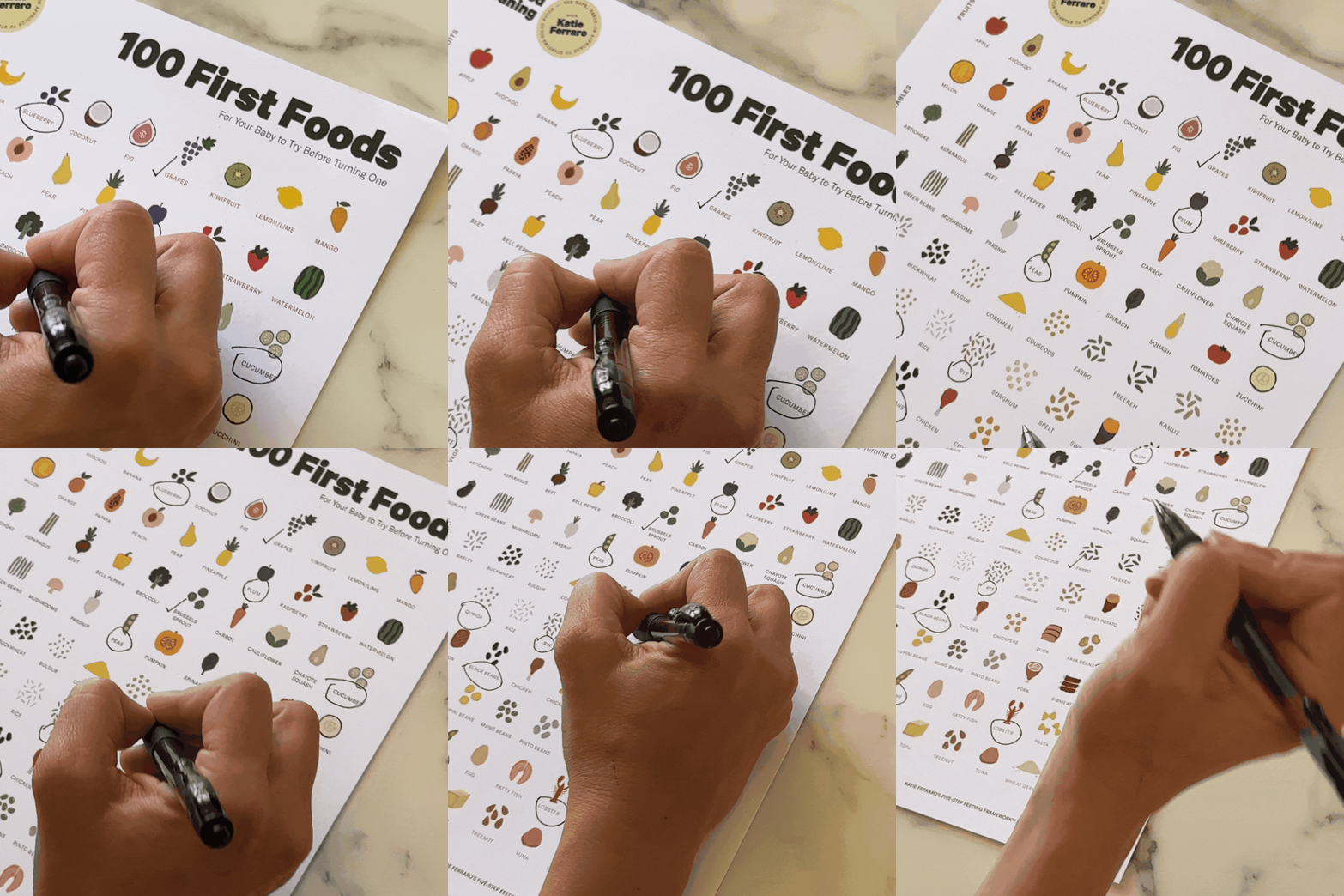
- Baby-Led Weaning for Beginners free online workshop with 100 First Foods™ list to all attendees, register here: https://babyledweaning.co/baby-led-weaning-for-beginners
Other Episodes Related to this Topic

Latest Episodes

Katie Ferraro (58s):
And I know the first few days at weeks of baby love, weaning can be torturous and you're like, nothing is happening, but you're actually doing a much better job than you might think you are. And here's three ways to tell a baby led weaning is going well, even if you don't feel like it is right now. Hey, there I'm Katie Ferraro Registered Dietitian college nutrition professor and mom of seven specializing in baby led weaning here on the baby led weaning made easy podcast. I help you strip out all of the noise and nonsense about feeding, leading you with the competence and knowledge You need to give your baby a safe start to solid foods using baby Led Weaning.
Katie Ferraro (1m 42s):
Well, hello there. Welcome back in this episode, I'm going to be doing a quick mini baby-led weaning training, showing you three Signs that baby led weaning is going well for your baby. Now some of you might be like it is not going well, but I think you might be surprised. We're going to talk a little bit about kind of redefining what a win and a success is, especially in the earlier stages of baby-led weaning. So I like to start out each of these mini BLW training episodes with the baby-led weaning tip of the day. And today's tip is, do not forget that your baby having a slow start to solid foods is typical.
Katie Ferraro (2m 22s):
Okay? That's what we expect to see. I don't know why, but for whatever reason, we have this idea sometime ingrained into our heads as parents and caregivers that right at the six month mark, there's some magical flip of the switch where all of a sudden our baby needs to get all their nutrition from food and not infant milk anymore. And that's definitely not true. Remember, infant milk, breast milk or formula will continue to be your baby's primary source of nutrition for the next few weeks and months as your baby gets more proficient at solid foods. Okay? By about the 12 month mark, that's where we want to see your baby getting most of their from food with much less reliance on infant milk.
Katie Ferraro (3m 3s):
Again, infant milk being breast milk or formula, but early on in baby-led weaning There's almost very minimal, actual eating, taking place. And remember, this is a six month trial period to learn how to eat. No one's expecting your baby to do everything right at the first days or weeks after you start give your baby a lot of time, a lot of space to practice learning how to eat. And if you're feeling like it's slow, remind yourself a slow start to solid foods is typical and hang tight. Because in this quick episode, I'm going to be sharing just a few tiny wins that I think are going to make you feel better. If you're maybe experiencing that sense of like, I'm just a little dejected here. My baby doesn't seem to be taking to feeding and it doesn't make things any better.
Katie Ferraro (3m 46s):
If you watch social media and you see other babies eating and you're like that babies, my babies agent, he or she is eating so much better. It doesn't work like that. Okay. All babies are different. Your baby will learn to eat on their own pace. And today I have three signs that BLW is Going Well for Your Baby. So I like alliteration. And I'm giving you three tips that start with T today. Okay. So the Signs that baby led weaning is going well, they all start with T we're talking about timing as number one, tilt as number two and trying new foods as number three. So number one, timing. How do you know baby led weaning is going well for your baby? Well, it's going well. If you've timed the start to solid foods correctly, okay?
Katie Ferraro (4m 25s):
Not all babies get ready to start solid foods right at six months. But we know that breast milk and or formula is sufficient to meet your baby's needs until about six months of age and six months adjusted age. If your baby was born prematurely. So from a nutrition standpoint, you don't need to offer anything except breast milk or formula prior to that. And from a developmental standpoint, the second part of timing, it's not just the six month thing. It's also waiting until your baby can sit relatively unassisted on their own and not all babies can do that right at the six month mark, some babies are six months plus one week or two weeks. I'm actually just getting ready to start solid foods in a baby-led weaning experience with a mom that lives close to me here in Southern California and her baby Braden will be documenting the baby's first 10 days with baby-led weaning.
Katie Ferraro (5m 12s):
And you can kind of anticipate when you'll start. So I'm always planning the menu and getting all the gear ready and getting the schedule ready with the mom for when we're going to meet. But none of it matters. And all the schedule goes to, you know, what, if the baby's not sitting up on their own. So I met the baby at six months plus one week. I mean, this baby was not even close to sitting up on her own. Mom's like, look, she could sit and was like, try to make her sit and was like, that's not even close to sitting. Like, well, she can sit in the Bumbo. That's not city sitting on her own relatively unassisted. The baby was just like laying flat on her back, which is fine, but she doesn't have the core strength yet to support and facilitate a safe swallow if she can't sit up on her own. So no way would I ever put anything in front of that baby except breast milk or formula until that time.
Katie Ferraro (5m 52s):
So the timing is key. Okay. Baby led weaning is going to be going well for you. Even if you don't feel like it is if you timed it. Right. Okay. Because none of this is safe to do if you're starting too early. So nutritionally, there's no benefit to starting about four, six months of age and then developmentally your baby's not ready until they can sit up on their own. You've got to have both of those pieces together and don't worry if it doesn't happen right at six months done a full-blown literature review. There's absolutely no data to show that waiting until closer to seven months of age to start solid foods is detrimental to your baby. Now you definitely can't wait too long. We do know that the longer you wait to start solid foods further on in infancy, there are negative impacts on your baby's acceptance of foods, because if they go too long, they're not going to be getting the practice that they need with all the different textures.
Katie Ferraro (6m 35s):
So I don't advise going past seven months of age and I'll tell you, in my experience, almost all neuro-typical children are sitting on their own by seven months of age. And if you're a baby was born full term and not sitting at seven months of age, that's definitely something to be talking to your primary care practitioner about. And on top of that, if your baby was born prematurely, it's a whole different ball game. And you have to do a little bit of math with the adjusted age. So I have a whole podcast episode about premature babies and how to estimate and adjust age for starting solids that's episode. Number one 19, if you go to BLW podcast.com/ 1, 1 9, you can listen to that and learn how to do the math. Okay? Cause your six month old baby, if they're born, premature has not six months of age.
Katie Ferraro (7m 16s):
Okay. You got to wait until that adjusted age. So tip number one is the timing tip. Number two is the tilt. This concept of the positive tilt and your baby leaning towards the food. Positive tilt is a term. It's also an area of study coined by Marsha Dunn Klein. A very noted leader in the pediatric feeding space. Marcia very graciously came on to explain the whole history of her positive tilt approach and her get permission approach. So that we're, if you're confused about what your baby's cues are telling you, you've got to listen to Marsha, teach about her positive tilt and that's episode 2, 3, 6. We want your baby leaning towards the food. Okay?
Katie Ferraro (7m 56s):
Sometimes parents are like, it's time to start solid foods and the baby's not picking it up or leaning towards the food. So I'm going to push it in their mouth. Kate with baby Led Weaning, the baby is the one driving the eating experience. Okay. And we need to learn to recognize and respond to our baby's cues. And Marsha has such a fabulous way of teaching us about the positive tilt. And she does a lot of teaching of that episode to showing you what not to do. Okay? Because if your baby is shirking or shying away or turning their mouth or their face away, you know that from responsive feeding from bottle feeding or breastfeeding, that that's a sign. Your baby's not interested in eating. Don't forget to observe these same cues when you make that transition to solid foods. So we want to see that positive tilt again, episode 236 by Marsha, Don Klein.
Katie Ferraro (8m 38s):
Awesome info in there for learning more about that. My third tip or sign that baby led weaning is going well for your baby is that you're trying new foods. Okay. I created a five step feeding framework that goes along with my hundred FIRST FOODS approach. We started this back in 2016, where you introduce five new foods per week to your baby. And this dovetails so nicely with all of the emerging research, showing us the benefits of diet diversity, meaning that we really need to take advantage of the flavor window, the short period of time, where your baby will like and accept a wide variety of foods. But we also know that, you know, a variety of foods does not magically appear on your baby's table.
Katie Ferraro (9m 19s):
And too often parents get stuck on those simple starter foods, avocado, banana, and sweet potato, and they do them over and over and over again. Okay. And that's fine for the first three days of solid foods, but avocado, banana and sweet potato. They don't have any iron. Those are not allergenic foods. There's not different texture experiences for your baby. If you just repeat those three foods, your baby's not getting the wide array of exposure that they need in order to achieve diet diversity. And so if you follow the five step feeding framework where you introduce five new foods per week, that's 20 foods per month. And in five months before your baby turns one, your baby will have eaten 100 different foods.
Katie Ferraro (9m 59s):
And the whole premise behind by a hundred FIRST FOODS approach is that we know that with traditional or conventional spoon-feeding, most babies have only had 10 or 15 foods. By the time they turn one and almost all children will experience some degree of food neophobia or picky eating after they turn one. So if your baby only has 10 or 15 foods and you lose those 10 or 15 foods to picky eating, that becomes a very challenging child to feed. But if your baby has a hundred foods and then you lose 115 of those to picky eating, no big deal, right? Because you still have 85 or 90 or more foods that your baby will like and accept. So I would encourage you to pick the five foods each week. Most families do it on Sunday, getting prepped for the week. We do a new fruit on Monday, a new vegetable on Tuesday, a new starchy food on Wednesday, a new protein food on Thursday and a new allergenic food.
Katie Ferraro (10m 43s):
On Friday, we feed the allergenic food twice on Friday, twice on Saturday, twice on Sunday with no other new foods across the weekend, but do continue to reintroduce those familiar foods. From previous days, following that framework, you won't lose steam. Even if at the beginning, you're like I did buy foods and the baby hardly ate anything. And it's funny because parents will ask and be like, well, what does it taste actually like when you actually check the food off your a hundred FIRST FOODS list, Katie. And it's funny because I've had a lot of conversations with, especially Carina Venter. Who's a researcher in the food allergy space and doing a lot of this work on diet diversity. Corina was on a number of times in the podcast that episode 84 is called why you don't need to wait three to five days between new foods with Carina Venter. And we're talking about the importance of kind of speeding up exposures for baby.
Katie Ferraro (11m 27s):
And I said, you know, in your research Kareena, what constitutes the taste? She says, oh, the baby has to swallow the food in order for us to count it. I'm like, are you serious? Because in my world, if the parent even makes the effort to make the food and put it on the plate, that counts as a win. Okay? So if you, you know, let's say you, do you make a lamb roaster, pork shoulder or some chicken. He keeps a lot of portions there. You're not just going to offer it once. Right? You try it once on the protein day. But if your baby doesn't eat it, you're trying it later that day. The next day, when you try the allergenic food, you're going to bring that protein food back and keep it in that rotation. And eventually your baby will pick it up. They will lick it. They will taste it. But the likelihood of that happening the first time, or even the first few times almost zero.
Katie Ferraro (12m 8s):
So don't get down on yourself. If you feel like your baby's not even interacting with the food, you making the effort to try and offer new foods. That's the very, very important first step of this process. Your baby will catch up. And then generally by, after you've been doing this for about eight weeks. So for most parents, by the time the baby turns eight months, if you start it at six months, everything kind of starts to click. And I love when I get messages from parents of eight and nine month old babies who are like you were right. The click happened, everything kind of got in sync. And my baby finally started taking to solid foods and the decision to do baby-led weaning and the a hundred FIRST FOODS approach was one of the best parenting decisions that I ever made. I love those messages, keep them coming because I know a lot of get a lot of messages from the really stressed out parents at the beginning.
Katie Ferraro (12m 48s):
But I love to hear the success stories down the road as well. So hang in there, if you need ideas on the five foods to offer each week and a hundred foods to do in the time before your baby turns one, you can grab a copy of my hundred FIRST FOODS list on my free online workshop. This is a one hour video training called BABY-LED WEANING FOR BEGINNERS. I teach you all about the first 10 days of baby-led weaning. So we're going to get you through that five step feeding framework for the first two weeks. I show you how to make the food safe. We talk about the importance of allergenic foods and try new textures so that you walk away from that one hour training feeling like this is something you can do and that you can do the correct way and the safe way. So you can sign up for this week's BABY-LED WEANING FOR BEGINNERS workshop times where you also can get that a hundred FIRST FOODS list just had to baby led weaning.co.
Katie Ferraro (13m 32s):
And I hope to see you on the workshop and hang in there. Your baby will get the hang of selfie.
The Program Baby-Led Weaning with Katie Ferraro
A step-by-step digital program for starting solid foods safely and navigating the original 100 FIRST FOODS™ meal plan with baby-led weaning.
 EXPERT-LED, PROVEN APPROACH TO EATING REAL FOOD
 CONCISE VIDEO TRAININGS TO MASTER BABY-LED WEANING
 100 FIRST FOODS DAILY MEAL PLAN WITH FOOD PREP VIDEOS
Baby-Led Weaning for Beginners Free Workshop
Is your baby ready to start solid foods, but you’re not sure where to start? Get ready to give your baby a solid foundation to a lifetime of loving real food…even if you’re feeling overwhelmed or confused about this next stage of infant feeding.
Get baby-led weaning recipes and tips delivered to your email inbox.